
模拟 · Minimal Logistik · Rail and combined transport
Lehrte · MegaHub
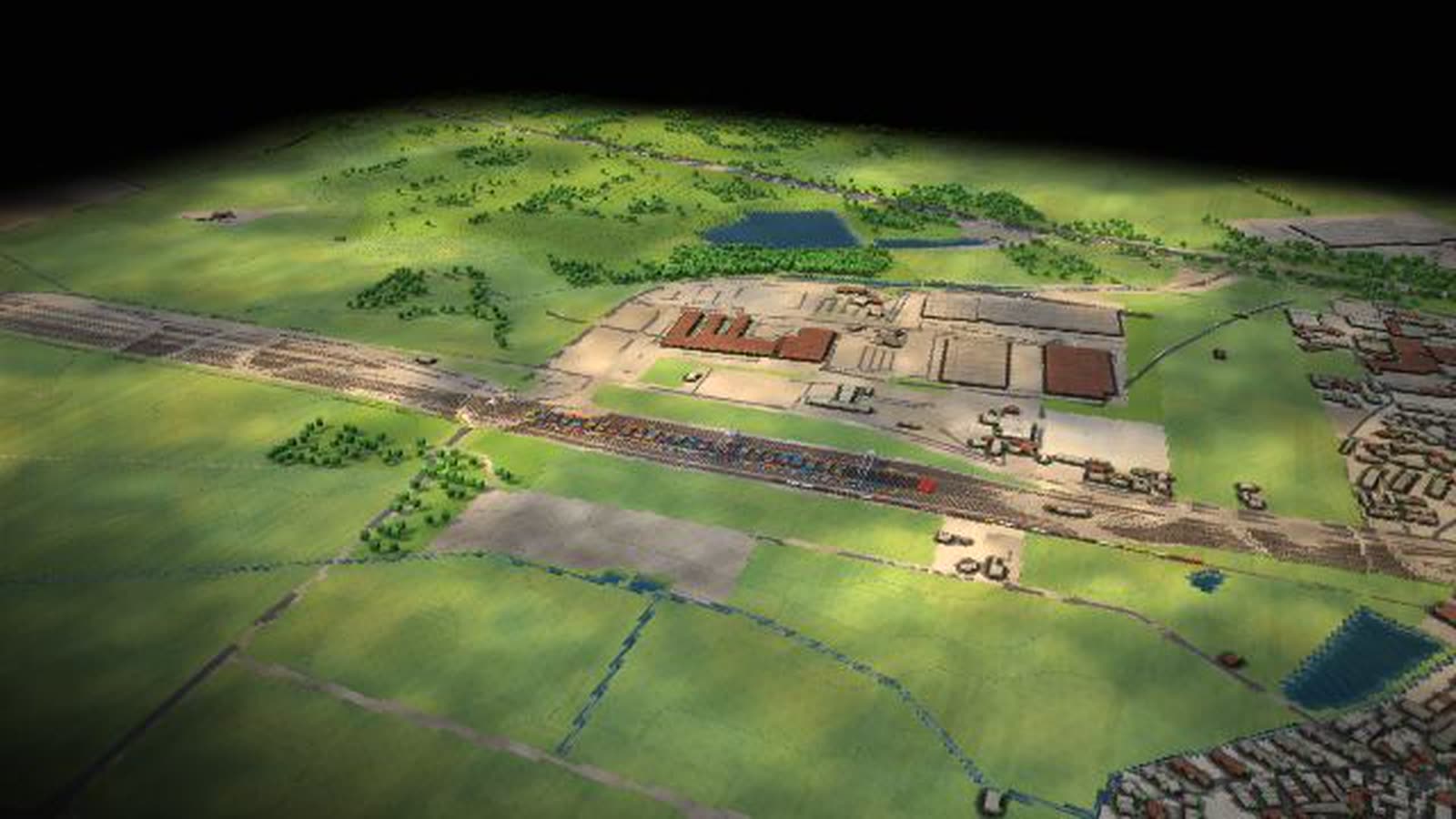
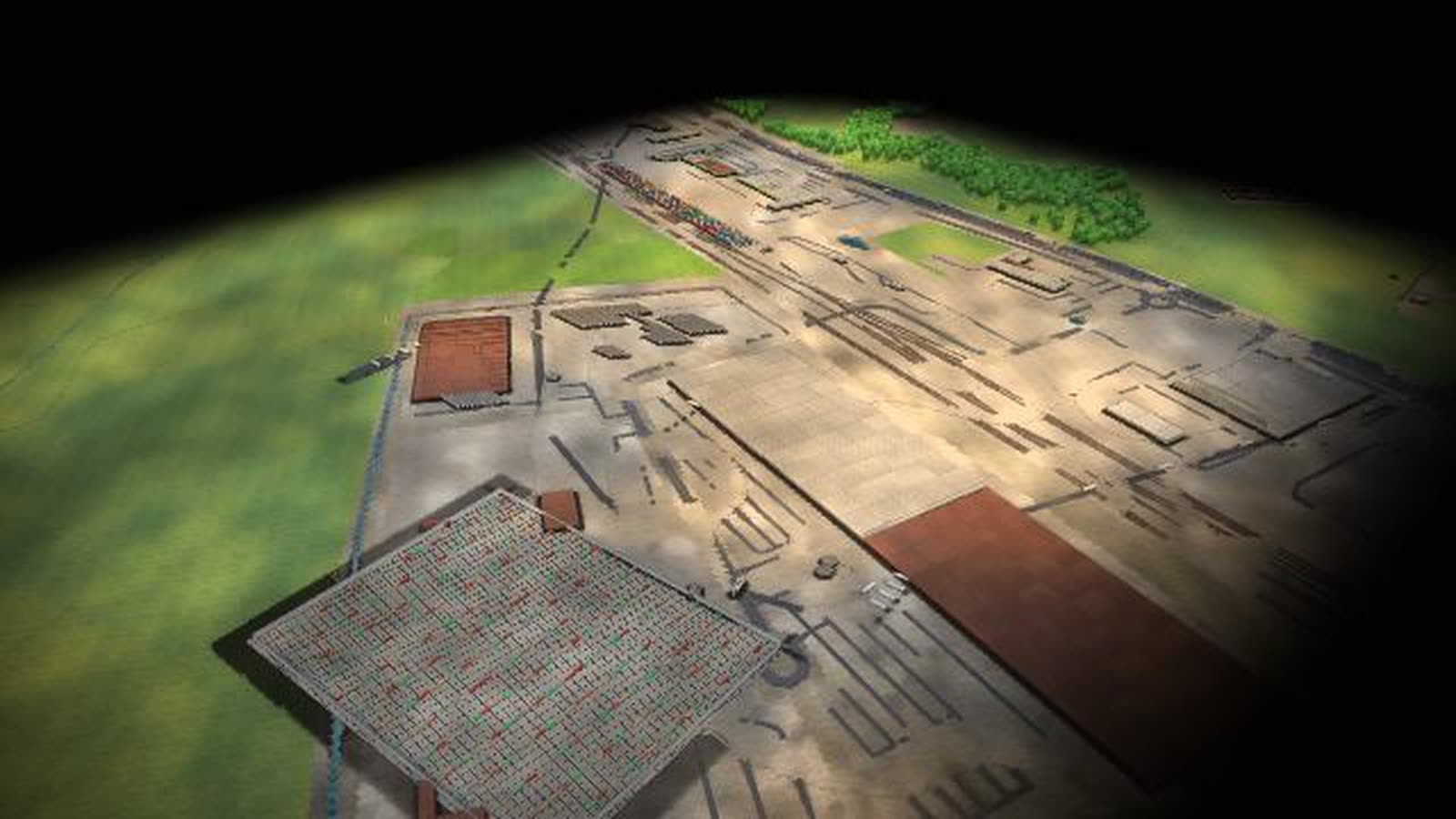
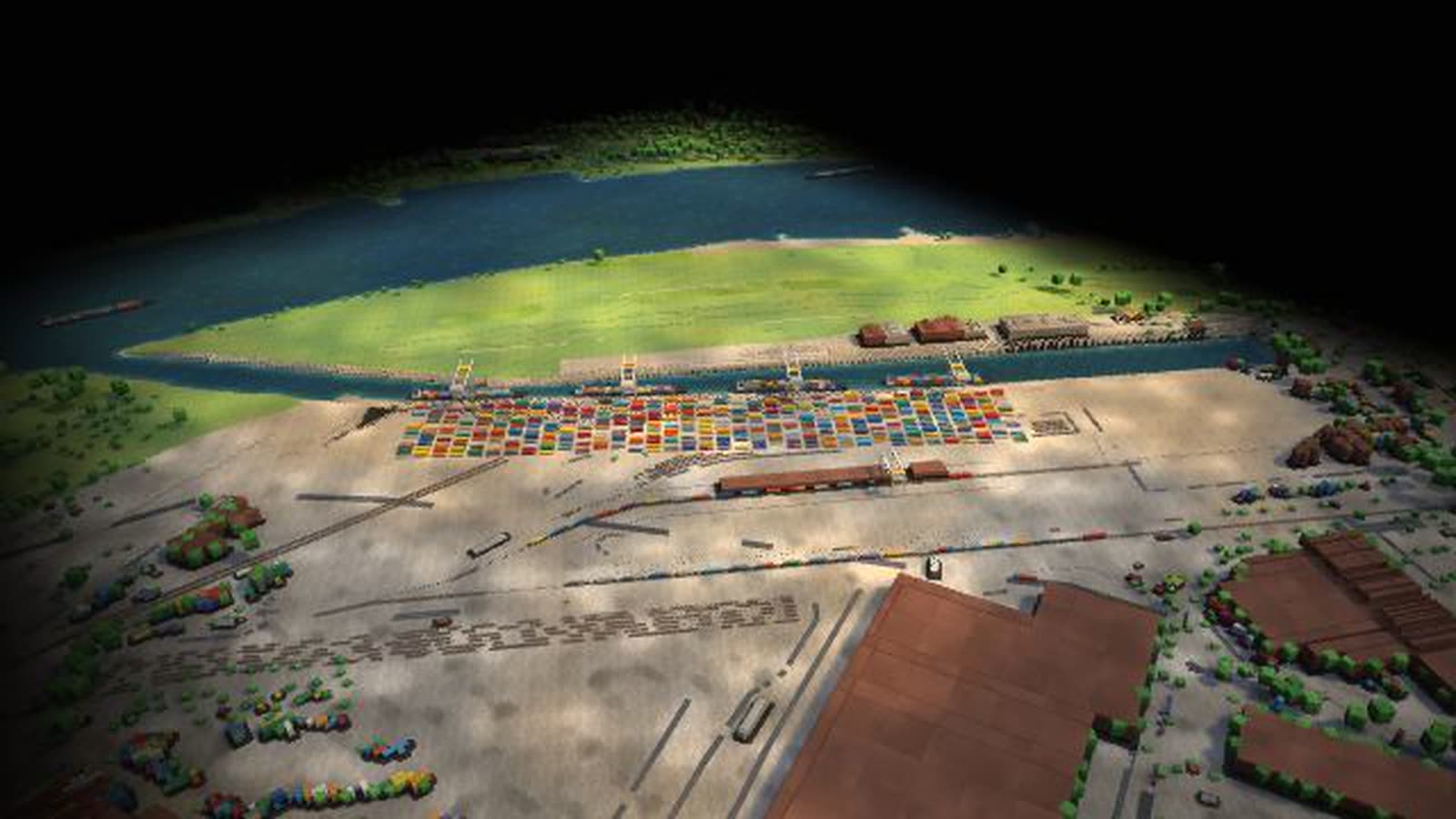
A train-to-train transfer facility as a walkable model: six tracks of 720 m each, three gantry cranes, driverless transporters – and freight trains regrouped without shunting.
Real are the location, terrain and buildings (open elevation data, OpenStreetMap) and the site profile figures. Volumes, rhythms and vehicle numbers are model assumptions, processes accelerated. With your data, the model also shows lifts per track, transfer times and trains per route.
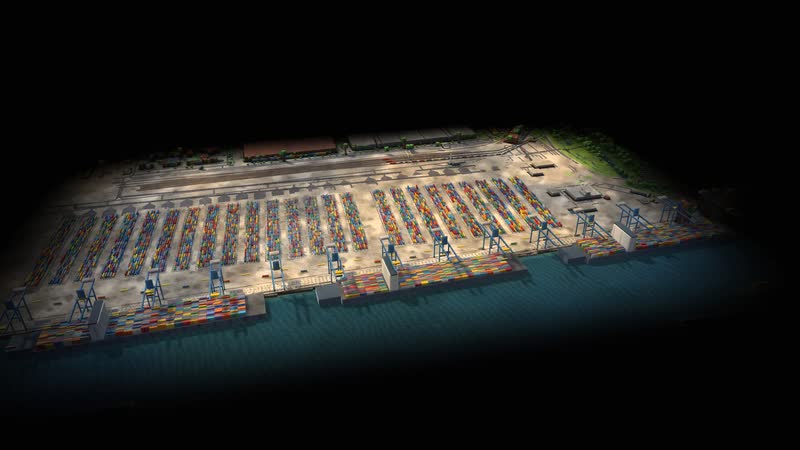
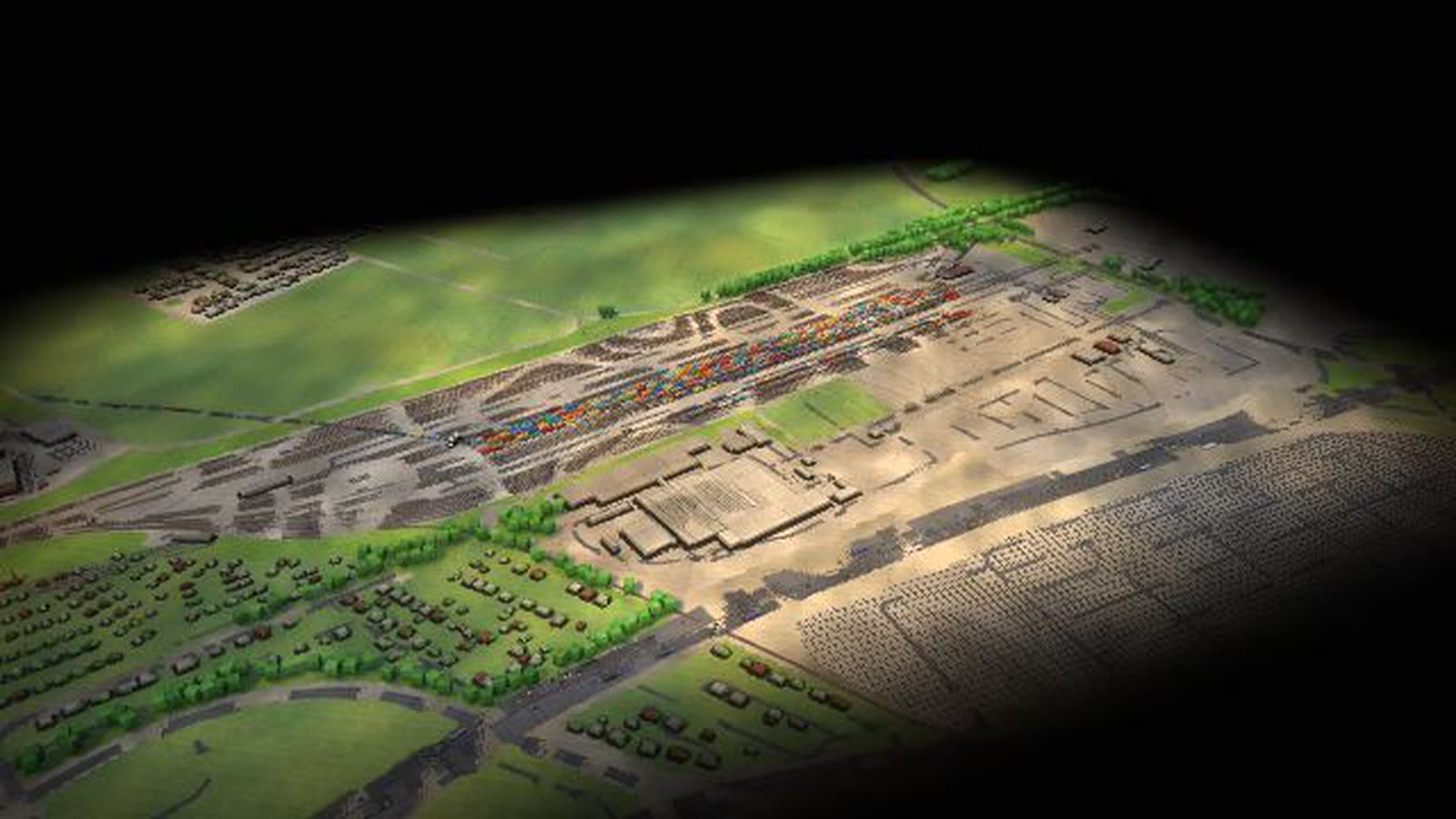
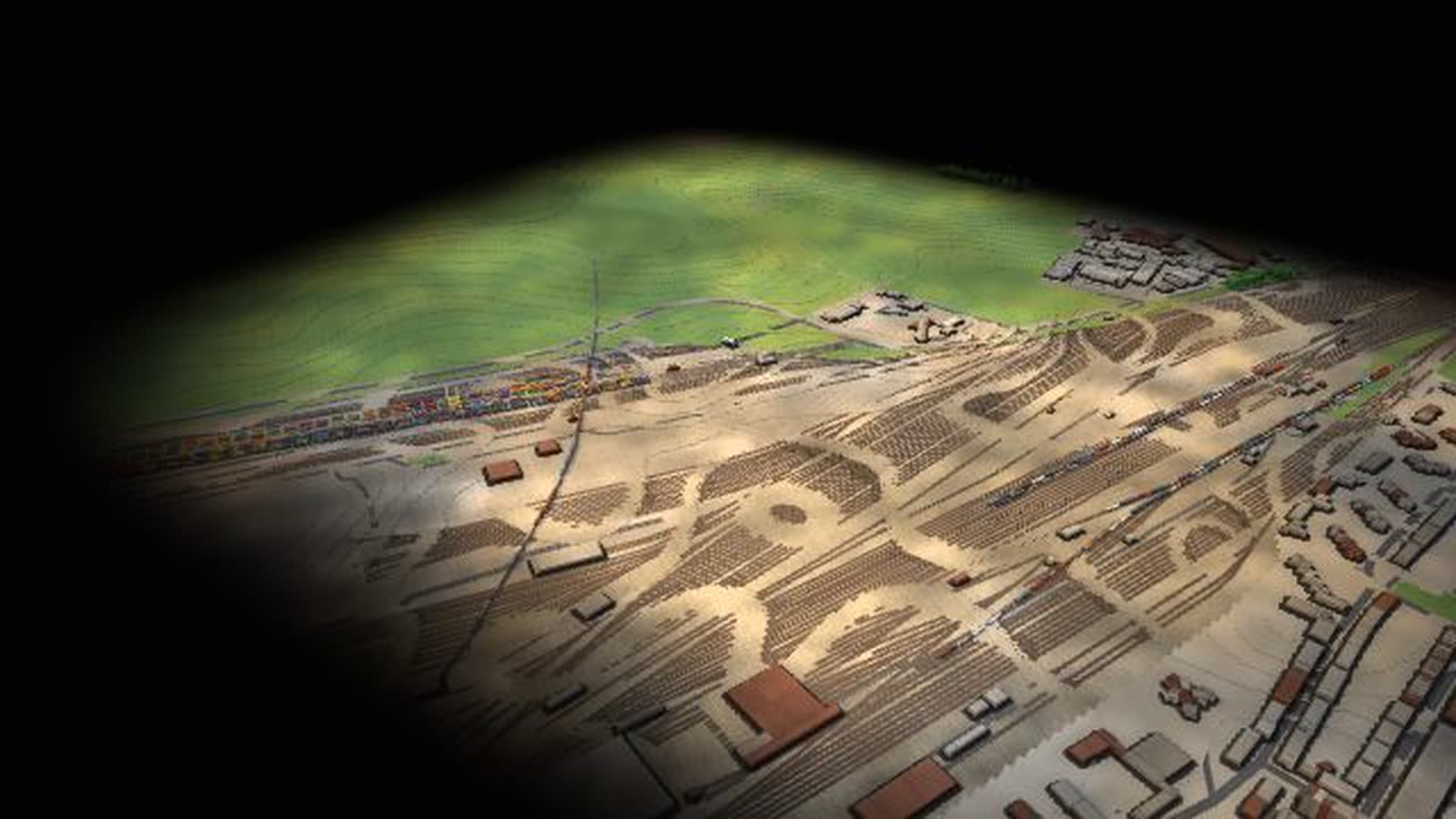
Train-to-train transfer at the Lehrte MegaHub near Hanover, as a running model: on the former marshalling yard, six tracks of 720 m each lie beneath three gantry cranes. The cranes manage up to 40 lifts an hour and work whenever a train stands in a track, while driverless transporters move containers from one end of the facility to the other.
Freight trains are regrouped this way – without shunting and without trucks. Alongside run the A2 east–west motorway and the Hanover–Berlin line, and large distribution centres line the A2. In the model, Lehrte belongs to the Hanover node: 82 % of its flows go by road, mainly on the A2 and A7, and the 18 % by rail are the MegaHub trains and the line from Wilhelmshaven to Hanover. A rail strike stops the handling, snow slows the A2. In the model, containers from Hamburg switch here to the train for Munich.
Real are the location, terrain and buildings, taken from open elevation data and OpenStreetMap, and the figures in the site profile, taken from public information – such as the final stage of about 269,000 transfers a year. Daily volumes, rhythms and vehicle numbers are model assumptions in the right order of magnitude; processes run accelerated. This page is for rail and terminal operations, network planning, logistics companies, the region and economic development, chambers, schools and universities.
A train in the terminal (riding along, key F)
- 01
arriving
- 02
being loaded
- 03
departing
What is shown – why – for whom
| 展示内容 | 为什么 | 适用对象 |
|---|---|---|
| MegaHub: six 720 m tracks beneath three gantry cranes | 为什么Shows the facility at a glance. | 适用对象Terminal operations, teaching |
| Gantry cranes with up to 40 lifts an hour | 为什么Shows the handling rhythm. | 适用对象Network planning, universities |
| Driverless transporters beneath the cranes | 为什么Explain how a box reaches its new train. | 适用对象Onboarding, schools |
| A2 near Lehrte with tailback towards Hanover | 为什么Shows the road next to the rail. | 适用对象Region, transport planning |
| Distribution centres on the A2 | 为什么Show what goes into the region by truck. | 适用对象Logistics companies, economic development |
| Supply chain ‘Containers Hamburg → Munich’ | 为什么Shows consolidation instead of shunting. | 适用对象Public relations, exhibitions |
| Rail strike, snow and ice | 为什么Show what hits the hub. | 适用对象Rail operations, associations |
Facilities and areas in the model
-
MegaHub
Six 720 m tracks, three gantry cranes with up to 40 lifts per hour each; final stage about 269,000 transfers a year (operator figures).
-
Gantry cranes
The cranes work whenever a train stands in one of the tracks; driverless transporters carry containers from one end of the hub to the other.
-
A2 near Lehrte
The A2 is one of the main east-west axes; towards Hanover traffic backs up when demand exceeds capacity. Utilisation as on the map (model).
-
Distribution centres
Large halls on the A2: trucks bring and collect goods for the region.
-
Hanover–Berlin line
Freight trains pass without stopping on the main line.
Processes in the model
A train in the terminal (riding along, key F)
- 01arriving
- 02being loaded
- 03departing
A truck at the gate (riding along, key F)
- 01driving to the gate
- 02check-in at the gate
- 03driving to the loading point
- 04being loaded
- 05leaving
Traffic at the bottleneck (riding along, key F)
- 01driving
- 02stuck in a jam
- 03the tailback slowly clears from its end (model)
Supply chain ‘Containers Hamburg → Munich’ (passes through this site)
- 01Hamburg: containers from overseas are loaded onto a train heading south
- 02At the terminal station the train is loaded – forty to fifty containers
- 03By rail to Lehrte near Hanover, about 180 km
- 04Lehrte MegaHub: gantry cranes lift containers from train to train – no shunting
- 05Beneath the cranes driverless transporters carry the box to its new train
- 06On another train to Munich. The chain is an example (model)
Try the scenario ‘Rail strike’
- 01tap it in the deck
- 02vehicles, yards and traffic-light rings at the site react at once
- 03time 4× shows how it develops
- 04‘Back to today’
How a rail transfer facility can use the model
-
Operations and planning
The cranes work whenever a train stands in a track. The model shows how trains, crane lifts and driverless transporters interact – and what a rail strike shuts down.
适用对象Terminal operations, network planning
-
Onboarding and training
Ride along with key F: a train arrives, is loaded and departs. Alongside, a truck at the gate and a vehicle in the A2 tailback. One line says what is happening.
适用对象New staff, rail and logistics trainees
-
Local authorities and economic development
Consolidation without trucks: the model shows how a former marshalling yard becomes the node between Hamburg and Munich, next to the A2 and the Hanover–Berlin line.
适用对象Region, economic development, chambers
-
Schools, universities, museums
How do containers switch from one freight train to another without shunting? Crane and transporter show it step by step – also as a demo without anyone at the controls.
适用对象Schools, universities, museums and exhibitions
-
Public communication
The ‘Rail strike’ scenario shows at four times the speed how handling stops and stocks pile up – and one tap brings back today.
适用对象Public relations, associations
What you can change
Controls
- Economy: How much is produced and traded overall. Acts on all flows of Lehrte.
- Consumer demand: Container goods and food for retail. Weight here about 48 % of the volume.
- Industrial output: Raw materials, steel, parts, chemicals. Weight here about 52 % of the volume.
- Transport cost / tolls: Expensive roads shift freight to rail and water. Here 82 % of the volume goes by road.
- Season: Spring: more building materials and seed, raw materials +8 %, food +5 %. Autumn: harvest (food +18 %), Christmas run-up (containers +8 %), first heating oil deliveries. Winter: heating oil and Christmas trade, less road capacity.
Disruptions
- Disruption: Motorway: One lane remains, the detour loads the neighbouring routes.
- Disruption: Rail strike (hits this site hardest): Freight trains stand still, trucks and ships take over part, stocks pile up.
- Extreme weather: Snow and ice (hits this site hardest): Bottlenecks overloaded, canals partly frozen.
What the model gives a rail transfer facility
-
01
Consolidation made visible
From train to train without shunting: the model shows what the facility does – no slides, no diagram.
-
02
Rail and road side by side
Transfer facility, Hanover–Berlin line and A2 run at the same time; the site profile shows every part with live values.
-
03
Disruptions without damage
Rail strike, snow and ice hit this site hardest. Trigger them, then return to today.
-
04
Site and map in one model
Throughput, stock and utilisation are the same figures as for the Hanover node on the Germany map.
-
05
For visits and big screens
Runs in the browser and on large projections, with a demo that starts without anyone at the controls.
Your facility as a model
Would you like to see your tracks, cranes or train connections like this? Write or call us and we'll work out which train, crane and transfer data the model needs. The password is available on request.
cube4tec.de/spiele/minimal-logistik/
就此咨询
Minimal Logistik: Lehrte · MegaHub
Basis and limits
Real are the location, terrain and buildings of Lehrte (open elevation data and OpenStreetMap) and the figures in the site profile, taken from public information. Daily volumes, rhythms and vehicle numbers are model assumptions in the right order of magnitude; processes run accelerated.
Public sources the model is based on:
- OpenStreetMap contributors: map data (ODbL 1.0)
- OpenFreeMap / OpenMapTiles: vector tiles
- Terrain Tiles, AWS Open Data (Terrarium)
- Federal Transport Infrastructure Plan: project dossier Hanover-Lehrte
- Trade press: MegaHub Lehrte opens
- Federal Statistical Office: freight transport by mode
- German Environment Agency: freight emission data 2024 (g CO₂e per tonne-kilometre)
More places in the model
-
Hamburg · Container Terminal Altenwerder
An automated container terminal as a walkable model: up to 14 container gantries, driverless transport vehicles, the block yard, a rail station for trains up to 740 m and the truck gate.
-
Munich · Riem transhipment station
The transhipment station in the east of Munich as a walkable model: container trains from Hamburg, Bremerhaven and Italy, gantry cranes between train, yard and truck, and the A94 next door.
-
Kornwestheim · intermodal terminal and marshalling yard
A freight station and combined-transport terminal as a walkable model: gantry cranes between train and truck, a marshalling yard that re-forms freight trains, and car trains for export.
-
Großbeeren · freight village Berlin South
The freight village on the Berlin ring as a walkable model: distribution centres for retail and food, an intermodal terminal for goods from Hamburg, and the expressway the capital’s supply depends on.
-
Germany · freight flows and nodes
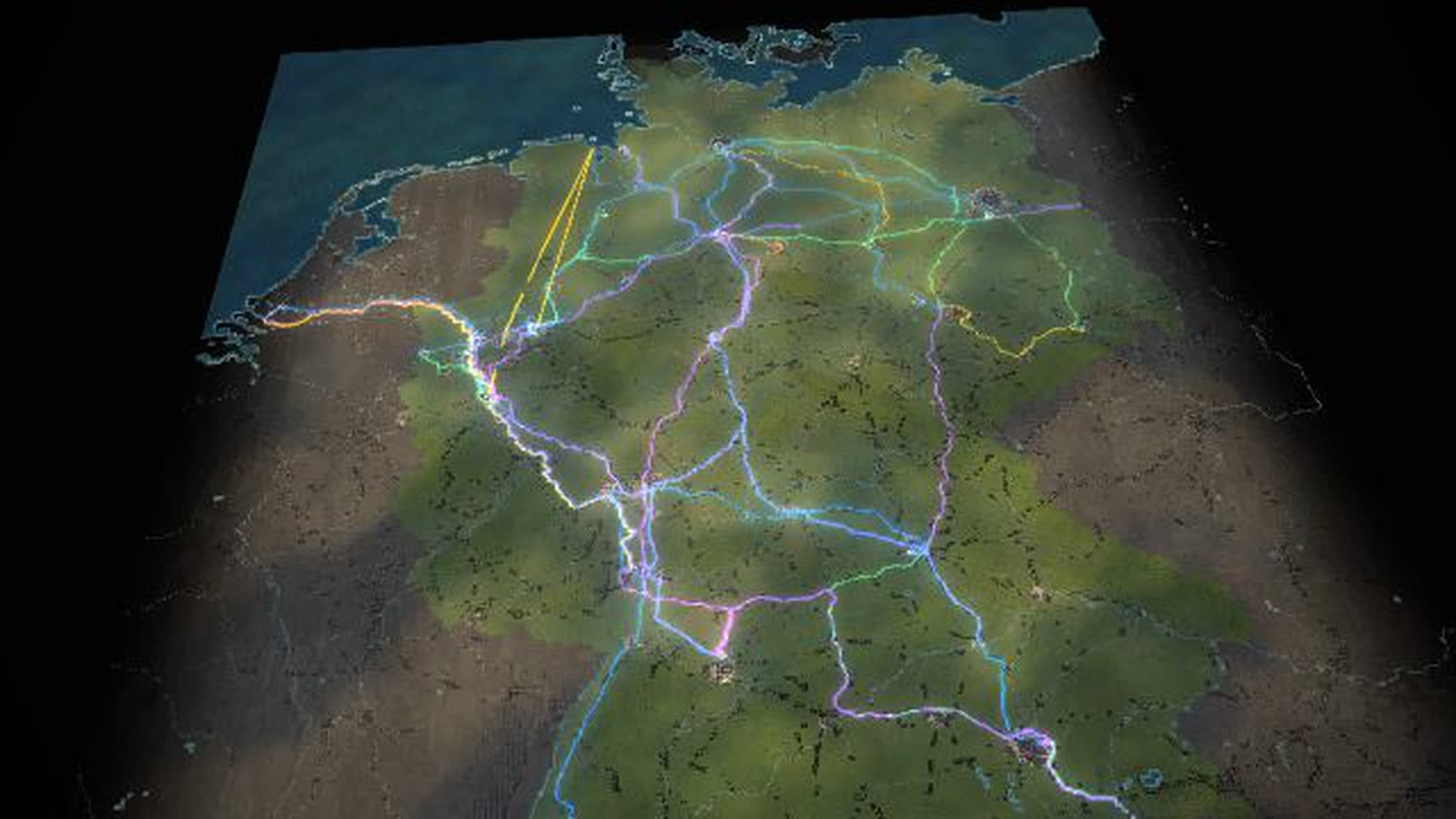
All of Germany as a map of blocks: 27 nodes, 55 freight flows as bands of light, eleven bottlenecks with traffic lights. Controls, seasons, disruptions and ten scenarios change every flow at once, compared with today.
-
Bremerhaven · car terminal and river quay
Bremerhaven as a walkable model: almost five kilometres of river quay for the largest container ships, straddle carriers, car trains and parking for about 95,000 vehicles at the mouth of the Weser.
-
Wilhelmshaven · JadeWeserPort and LNG terminal
Germany’s only deep-water port as a walkable model: the container quay on the Jade with straddle carriers and rail, plus the floating LNG terminal, a tank farm and the crude-oil pipeline to the refineries.
-
Duisburg · logport I (Rheinhausen)
A trimodal inland port on the Rhine as a walkable model: Rhine barges with sea containers from Rotterdam, gantries and yard, trains to the south, Eastern Europe and Asia, trucks into the region.
Real are the location, terrain and buildings (open elevation data, OpenStreetMap) and the site profile figures. Volumes, rhythms and vehicle numbers are model assumptions, processes accelerated. With your data, the model also shows lifts per track, transfer times and trains per route.