
模拟 · Minimal Logistik · Inland ports and industry
Duisburg-Schwelgern · works harbour and blast furnaces
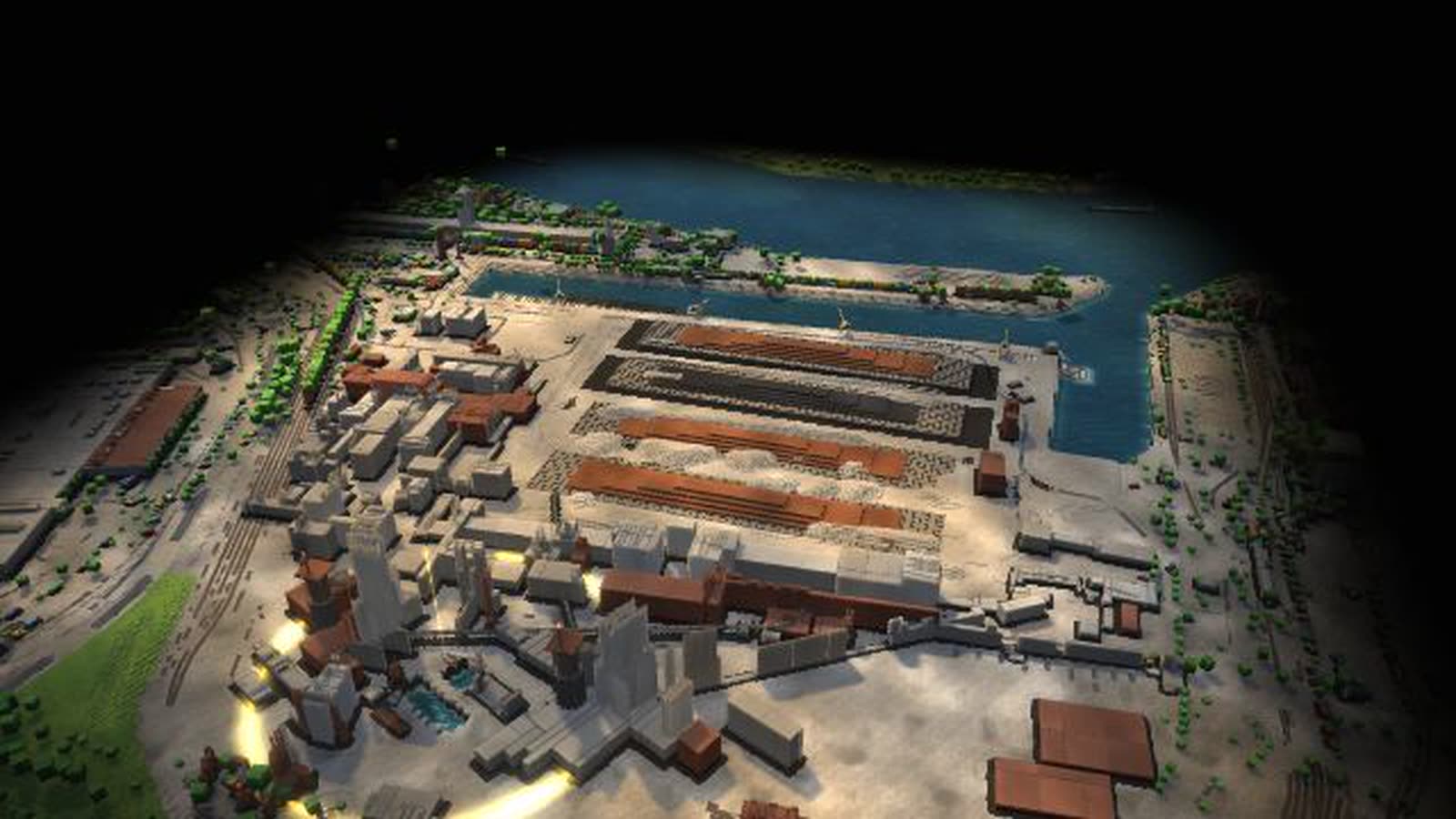
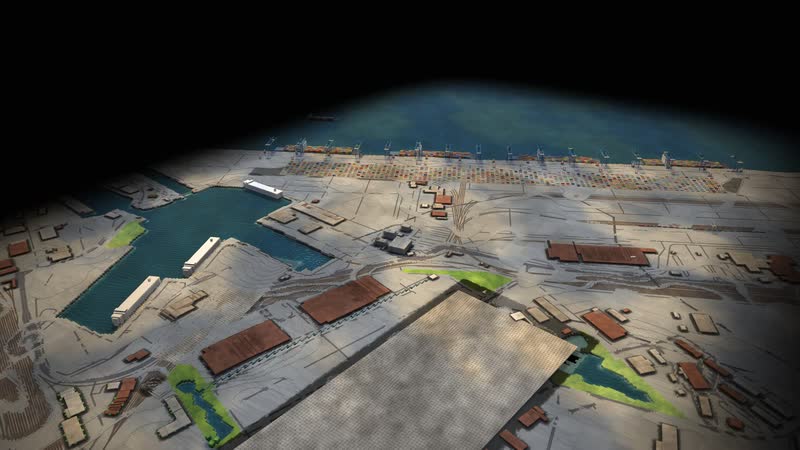
A raw-material chain as a walkable model: push convoys with ore and coal from Rotterdam, grab unloaders, ore and coal stockyards, conveyor belts and the Schwelgern 1 and 2 blast furnaces.
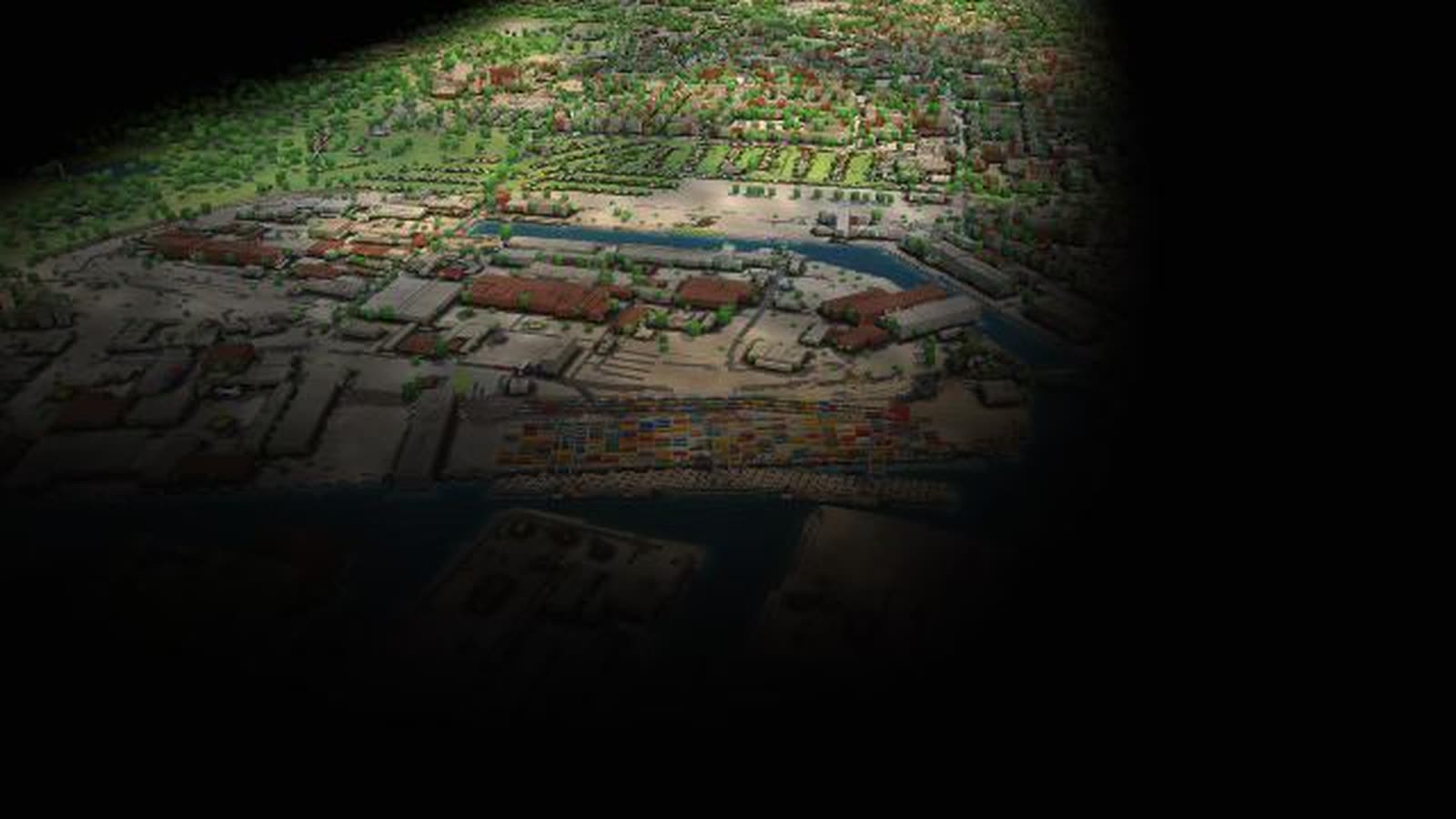
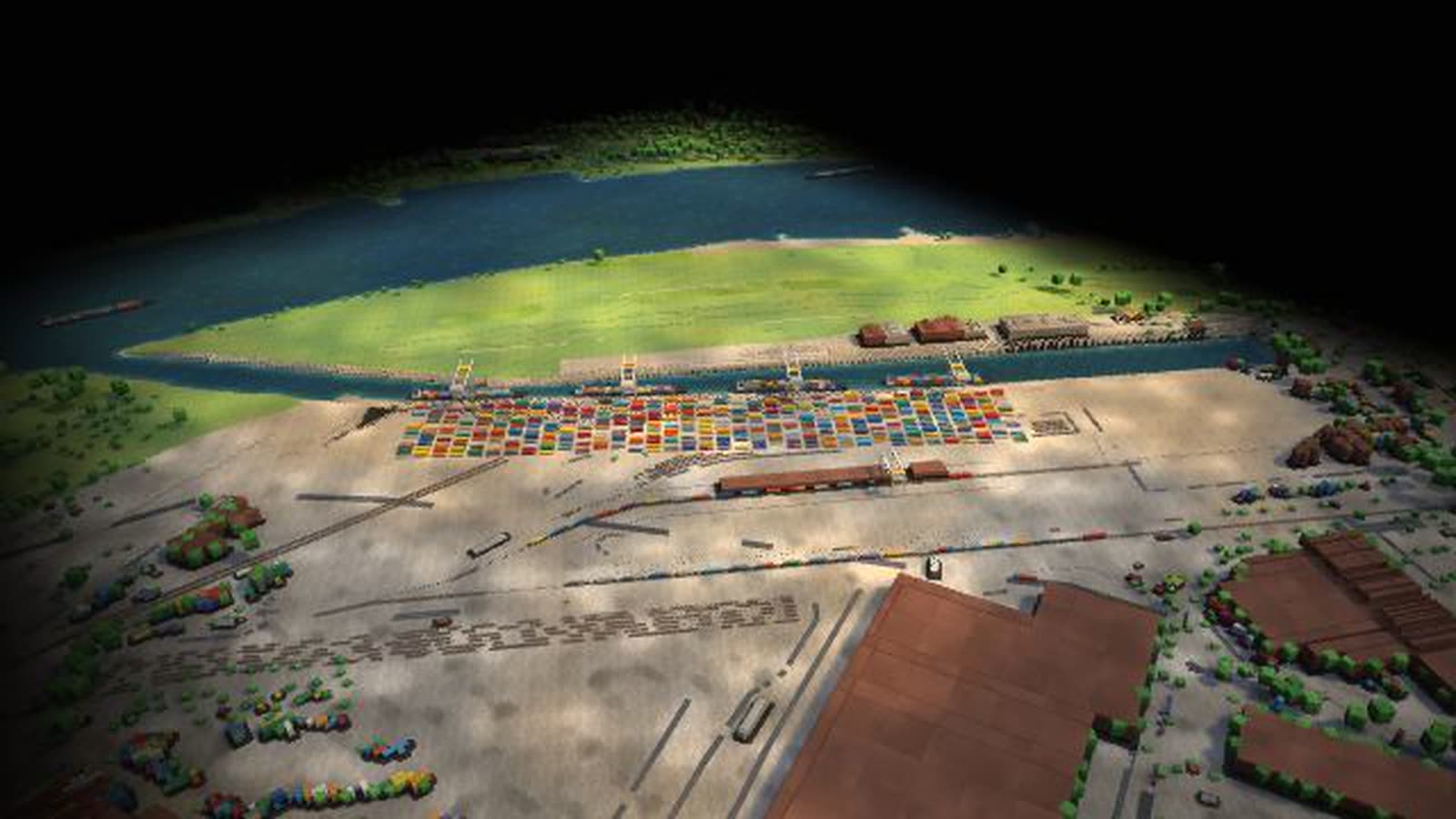
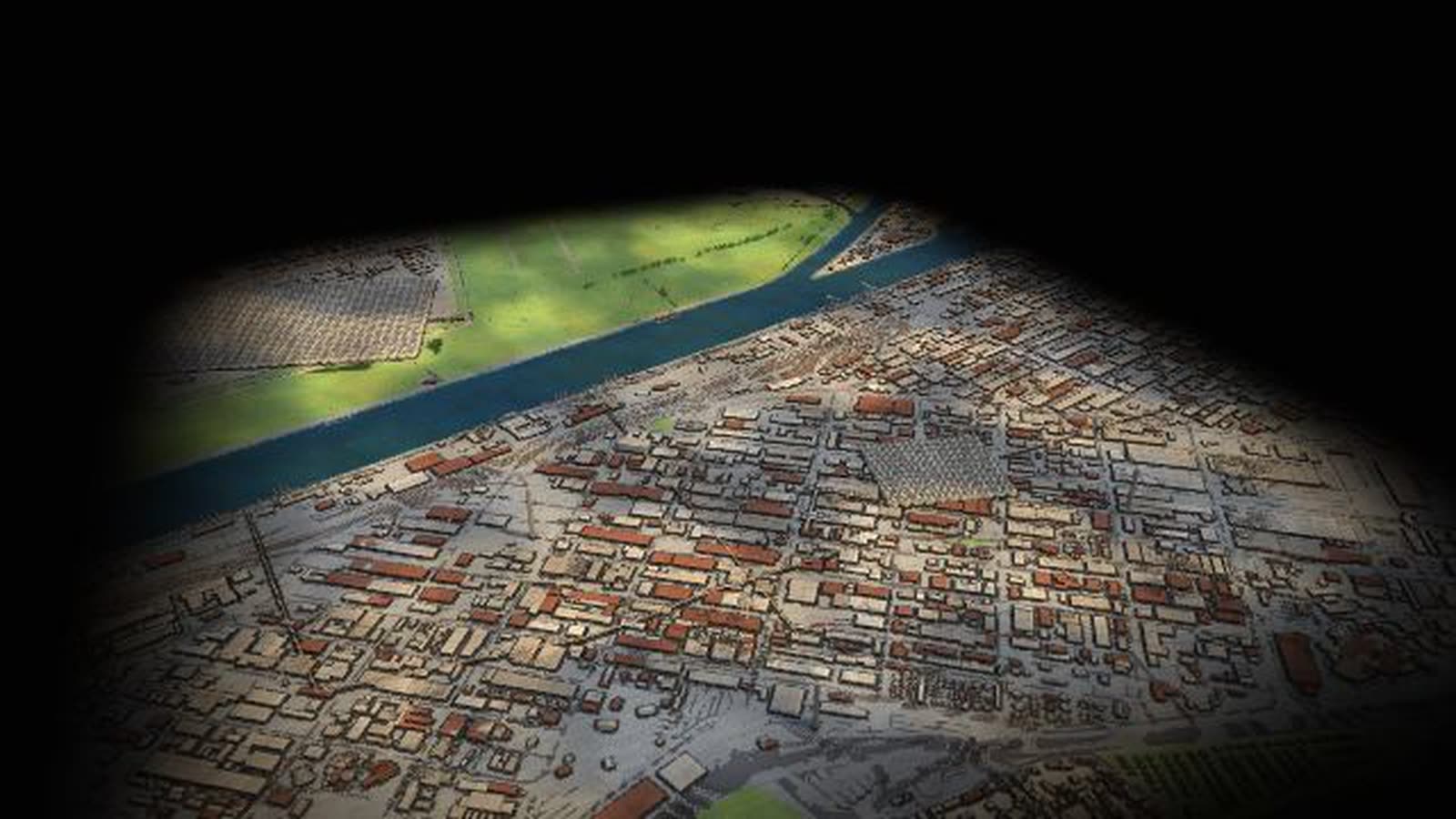
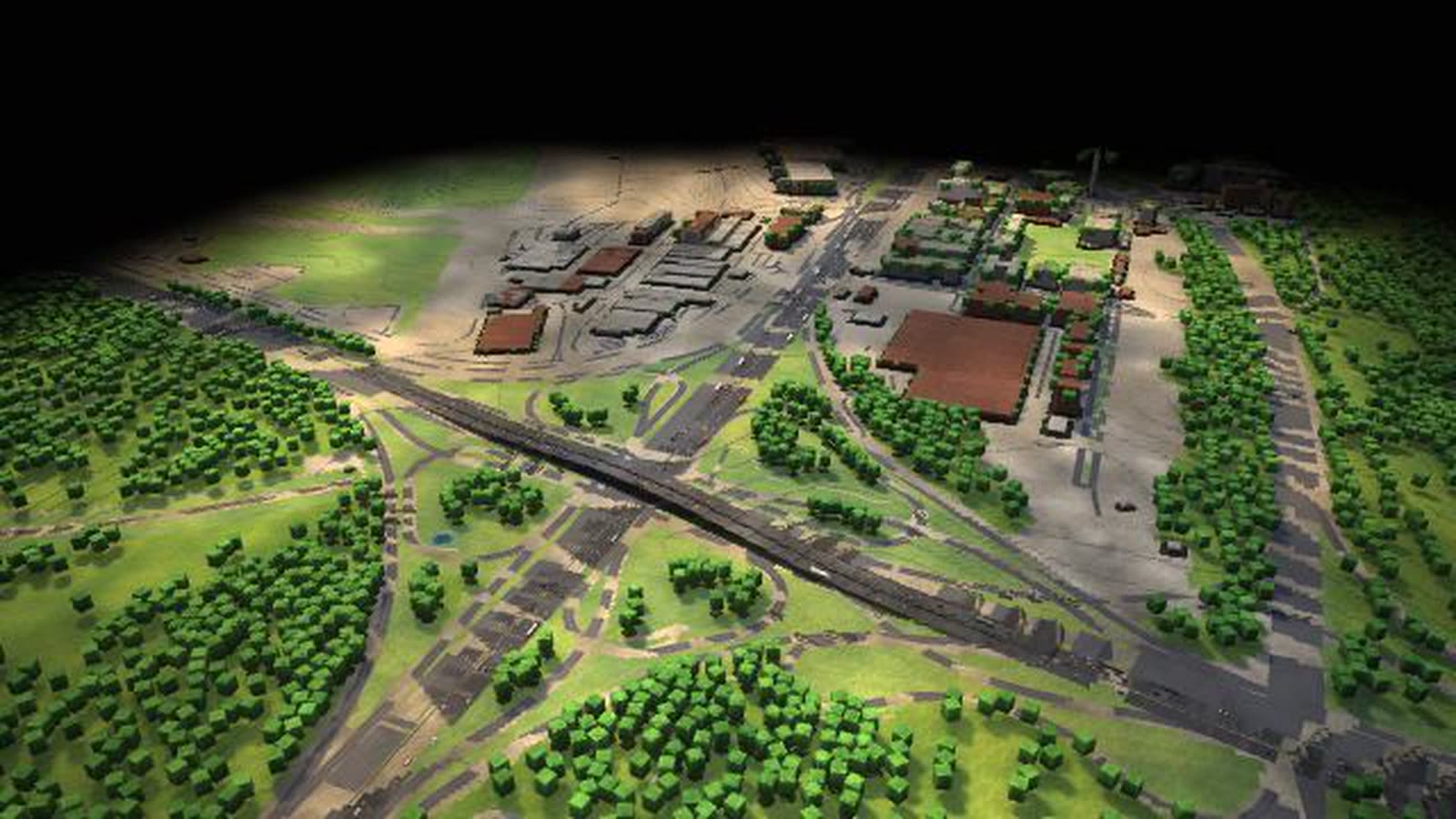
Real are the location, terrain and buildings (official NRW elevation data, OpenStreetMap) and the site profile figures. Volumes, rhythms and vehicle numbers are model assumptions, processes accelerated. With your data, the model also shows convoy arrivals, pile levels and tonnes per water level.
Iron ore logistics to the blast furnace, as a running model of the Schwelgern works harbour: push convoys with up to six lighters, about 15,000 t together, bring ore and coal from Rotterdam. Grab unloaders discharge about 10,000 lighters a year onto the ore and coal stockyards, whose pile height follows the node’s stock.
Conveyor belts feed the blast furnaces. Schwelgern 1 produces up to 3.6 million t of pig iron a year, about 10,000 t a day, and torpedo ladles carry it to the steel plant. Container, tank and push convoys pass by on the Rhine. In the model, 86 % of the volume arrives by water, almost all of it raw materials, and 96 % depends on industrial output. Low water means fewer tonnes per ship, a Rhine closure breaks the chain completely. The supply chain ‘Ore → steelworks → steel’ continues by rail to the Westfalenhütte plant in Dortmund.
Real are the location, terrain and buildings, taken from official NRW elevation data and OpenStreetMap, and the figures in the site profile, taken from public information. Daily volumes, rhythms and vehicle numbers are model assumptions in the right order of magnitude; processes run accelerated, and the rail route for the steel is an example. This page is for works and port logistics, planning, local authorities and structural change, chambers, schools, museums and exhibitions.
A ship in port (riding along, key F)
- 01
waiting at anchor
- 02
coming in
- 03
at the quay: being unloaded and loaded
- 04
leaving
What is shown – why – for whom
| 展示内容 | 为什么 | 适用对象 |
|---|---|---|
| Works harbour: push convoys with up to six lighters, about 15,000 t | 为什么Shows the scale of the deliveries. | 适用对象Port operations, teaching |
| Grab unloaders: about 10,000 lighters a year | 为什么Shows the unloading rhythm. | 适用对象Works logistics, onboarding |
| Ore and coal stockyards, pile height = node stock | 为什么Makes the reserves visible. | 适用对象Planning, plant management |
| Schwelgern 1 and 2 blast furnaces, pig iron in torpedo ladles | 为什么Shows what the raw materials are for. | 适用对象Schools, museums |
| Through traffic on the Rhine: container, tank and push convoys | 为什么Shows the works harbour on the river. | 适用对象Local authorities, inland shipping |
| Low water, flood and Rhine closure | 为什么Show how the chain depends on the water. | 适用对象Works logistics, associations |
| Supply chain ‘Ore → steelworks → steel’ | 为什么Links Rotterdam, the steelworks and Dortmund. | 适用对象Economic development, exhibitions |
Facilities and areas in the model
-
Schwelgern works harbour
Push convoys with up to six lighters (about 15,000 t) berth here; grab unloaders empty about 10,000 lighters a year.
-
Ore and coal stockyard
Pile height = stock of the hub in the model; with low water on the Rhine less tonnage arrives per ship.
-
Schwelgern blast furnaces 1 and 2
Industrial customer: Schwelgern 1 produces up to 3.6 million t of pig iron a year (about 10,000 t a day). Hot metal travels in torpedo ladles to the steel plant.
-
Rhine
Through traffic on the Rhine: container, tanker and push convoys between Rotterdam and the Upper Rhine.
Processes in the model
A ship in port (riding along, key F)
- 01waiting at anchor
- 02coming in
- 03at the quay: being unloaded and loaded
- 04leaving
A train in the terminal (riding along, key F)
- 01arriving
- 02being loaded
- 03departing
Supply chain ‘Ore → steelworks → steel’ (passes through this site)
- 01Rotterdam: iron ore from Brazil and Canada, coal – transferred onto push convoys
- 02Push convoy up the Rhine: up to six lighters, about 15,000 t
- 03Schwelgern works harbour: grabs unload the lighters onto the ore and coal stockyards
- 04Conveyors feed the blast furnaces – the industrial customer for the ore
- 05Steel from Duisburg by rail to Dortmund
- 06Westfalenhütte: processing (coating) – goods from Duisburg come here (documented), the rail route is an example
Try the scenario ‘Dry summer’
- 01tap it in the deck
- 02vehicles, yards and traffic-light rings at the site react at once
- 03time 4× shows how it develops
- 04‘Back to today’
How a works harbour can use the model
-
Operations and planning
In low water fewer tonnes arrive per ship, with the Rhine closed none at all. The pile height of the ore and coal stockyards follows the stock and shows it at once.
适用对象Works logistics, port operations, planning
-
Onboarding and training
Ride along with key F: a push convoy waits, comes in, is unloaded at the quay and leaves again. One line says what is happening.
适用对象New staff, port and steelworks trainees
-
Local authorities and economic development
The chain from Rotterdam via the works harbour to the Westfalenhütte plant in Dortmund shows how closely the Rhine, the steelworks and processing are linked in the region.
适用对象Local authorities, economic development, structural change
-
Schools, universities, museums
How do ore and coal reach the blast furnace? Push convoy, grab, stockpile, conveyor and torpedo ladle stand in one sequence – also as a demo without anyone at the controls.
适用对象Schools, universities, industrial museums
-
Public communication
The ‘Dry summer’ scenario brings low water on the Rhine: ships sail half loaded, and fewer tonnes reach the works harbour. Four times the speed shows how it develops, and one tap brings back today.
适用对象Public relations, associations
What you can change
Controls
- Economy: How much is produced and traded overall. Acts on all flows of Duisburg-Schwelgern.
- Consumer demand: Container goods and food for retail. Weight here about 4 % of the volume.
- Industrial output: Raw materials, steel, parts, chemicals. Weight here about 96 % of the volume.
- Transport cost / tolls: Expensive roads shift freight to rail and water. Here 0 % of the volume goes by road.
- Season: Spring: more building materials and seed, raw materials +8 %, food +5 %. Autumn: harvest (food +18 %), Christmas run-up (containers +8 %), first heating oil deliveries. Winter: heating oil and Christmas trade, less road capacity.
Disruptions
- Disruption: Rail strike: Freight trains stand still, trucks and ships take over part, stocks pile up.
- Disruption: Rhine closed (hits this site hardest): No ship between Rotterdam and Basel, rail and road at their limit.
- Extreme weather: Flood: Rhine closed, ships lie idle, rail and trucks take over where they can.
- Extreme weather: Low water (hits this site hardest): Ships sail half loaded, more trips, shift to rail.
- Extreme weather: Snow and ice: Bottlenecks overloaded, canals partly frozen.
What the model gives a works harbour
-
01
The raw-material chain in one piece
From the sea ship in Rotterdam to the torpedo ladle: the model shows every handover in one sequence, on the real site.
-
02
Dependent on the Rhine
In the model, 86 % of the volume arrives by water. Low water, flood and a Rhine closure show what that means.
-
03
Reserves made visible
The pile height follows the node’s stock on the Germany map and appears with live values in the site profile.
-
04
Industry as a lever
The industrial output control acts on 96 % of the volume here – more than at any other site in the model.
-
05
For visits and big screens
Runs in the browser and on large projections, with a demo that starts without anyone at the controls.
Your works harbour as a model
Would you like to see your harbour, stockyards or raw-material chain like this? Write or call us and we'll work out which delivery, stock and consumption data the model needs. The password is available on request.
cube4tec.de/spiele/minimal-logistik/
就此咨询
Minimal Logistik: Duisburg-Schwelgern · Werkshafen und Hochöfen
Basis and limits
Real are the location, terrain and buildings of Duisburg-Schwelgern (official NRW elevation data and OpenStreetMap) and the figures in the site profile, taken from public information. Daily volumes, rhythms and vehicle numbers are model assumptions in the right order of magnitude; processes run accelerated.
Public sources the model is based on:
- OpenStreetMap contributors: map data (ODbL 1.0)
- OpenFreeMap / OpenMapTiles: vector tiles
- Geobasis NRW: surface and terrain models DOM1/DGM1 (dl-de/zero-2.0)
- Press: low water at the Kaub gauge (2022)
- Trade press: gauge, Kaub, navigation ban – what matters about low water (2026)
- ELWIS: technical data of the waterways (Mainz, Würzburg, Hanover, Magdeburg)
- Federal Statistical Office: freight transport by mode
- German Environment Agency: freight emission data 2024 (g CO₂e per tonne-kilometre)
More places in the model
-
Dortmund · canal port and Westfalenhütte
The canal port at the end of the Dortmund-Ems Canal as a walkable model: canal barges with two tiers of containers, three container gantries, four tracks and the route to the Westfalenhütte plant.
-
Duisburg · logport I (Rheinhausen)
A trimodal inland port on the Rhine as a walkable model: Rhine barges with sea containers from Rotterdam, gantries and yard, trains to the south, Eastern Europe and Asia, trucks into the region.
-
Ludwigshafen · chemicals on the Rhine
A large chemical site on the Upper Rhine as a walkable model: tankers at loading arms, tank wagons on the works railway, pipe bridges, the Friesenheimer Insel tank farm and the container quay.
-
Germany · freight flows and nodes
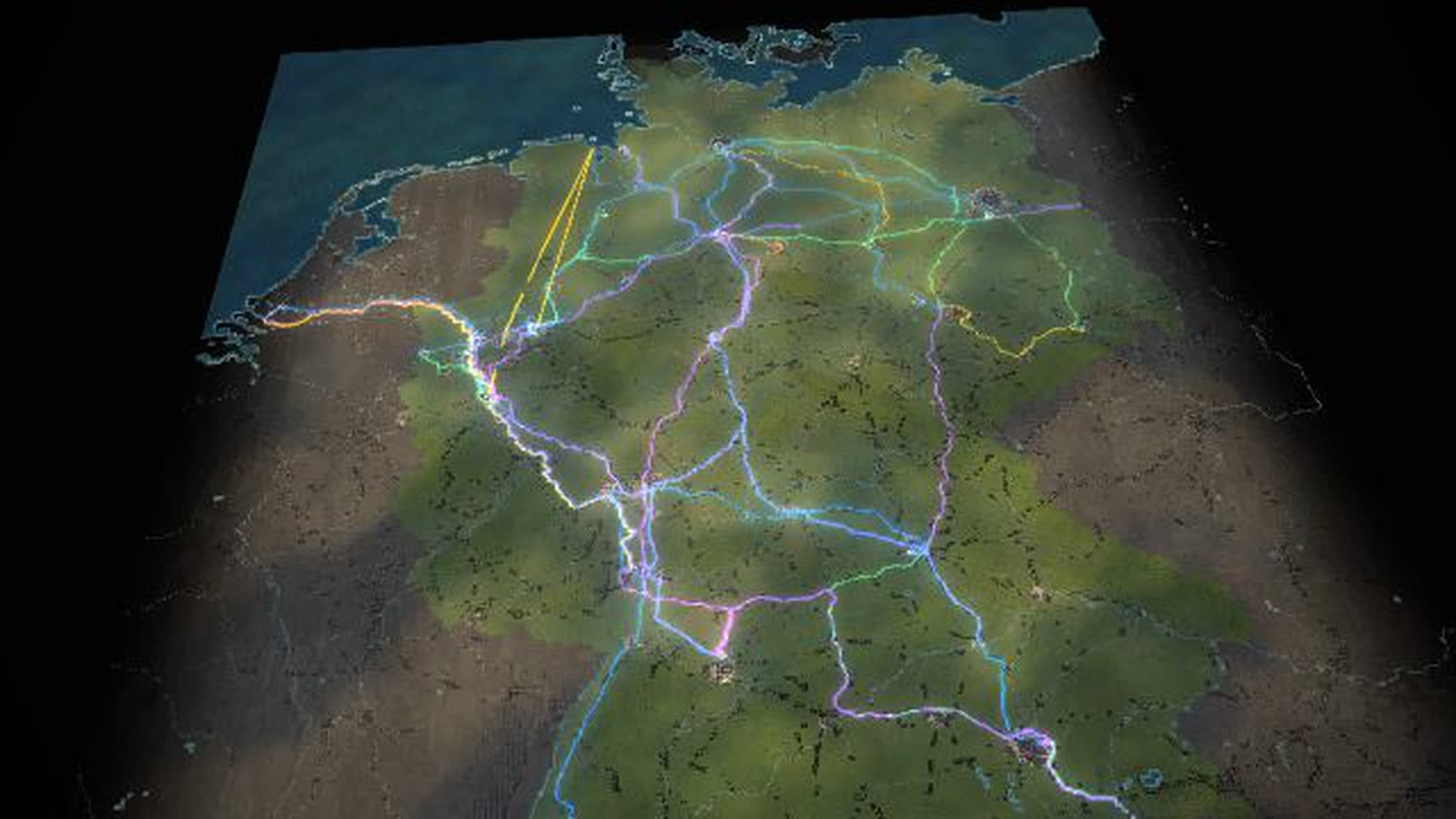
All of Germany as a map of blocks: 27 nodes, 55 freight flows as bands of light, eleven bottlenecks with traffic lights. Controls, seasons, disruptions and ten scenarios change every flow at once, compared with today.
-
Hamburg · Container Terminal Altenwerder
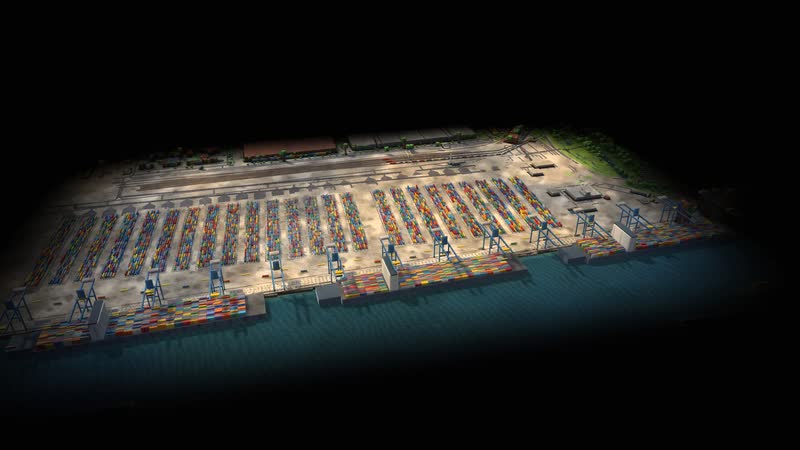
An automated container terminal as a walkable model: up to 14 container gantries, driverless transport vehicles, the block yard, a rail station for trains up to 740 m and the truck gate.
-
Bremerhaven · car terminal and river quay
Bremerhaven as a walkable model: almost five kilometres of river quay for the largest container ships, straddle carriers, car trains and parking for about 95,000 vehicles at the mouth of the Weser.
-
Wilhelmshaven · JadeWeserPort and LNG terminal
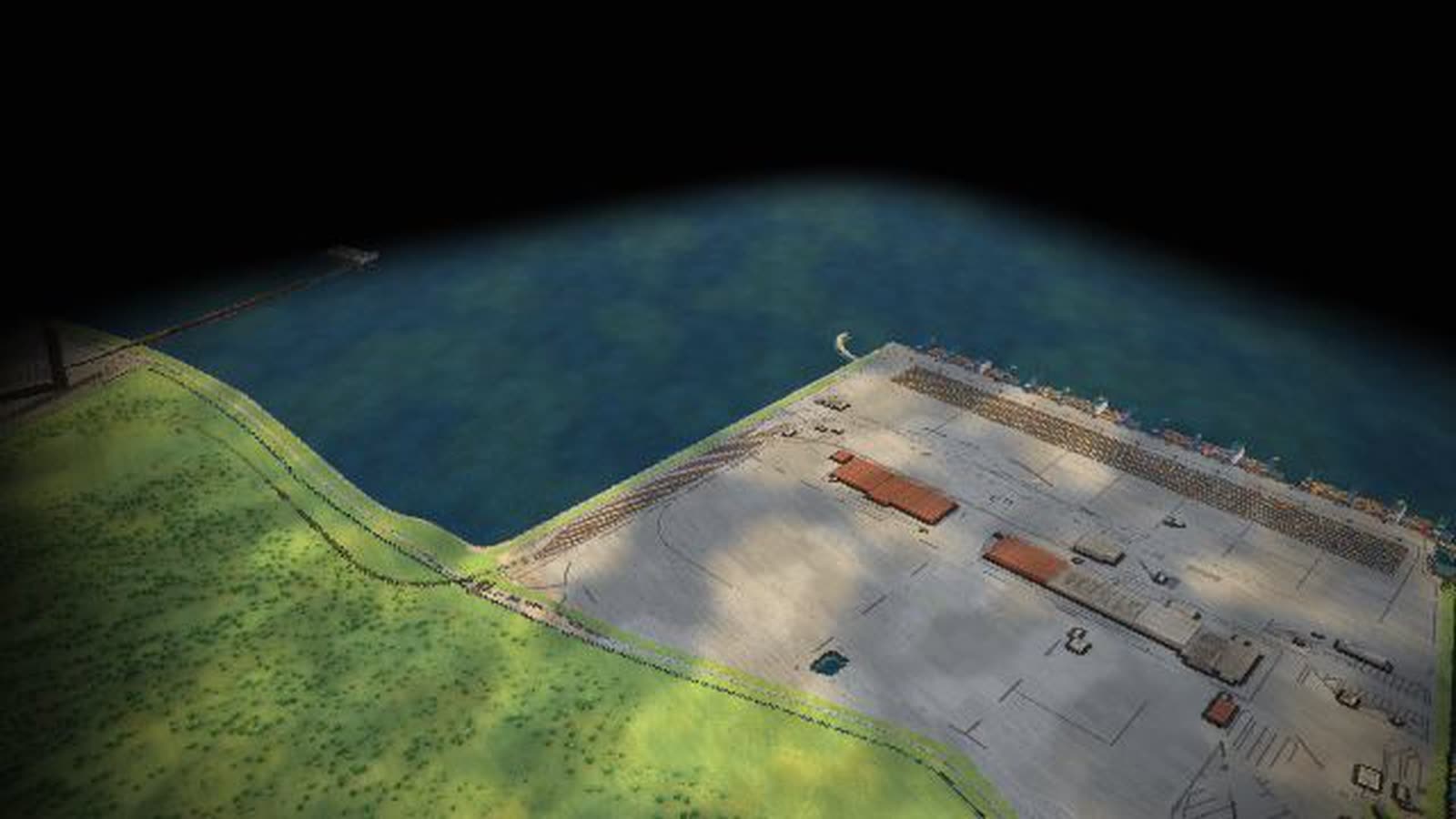
Germany’s only deep-water port as a walkable model: the container quay on the Jade with straddle carriers and rail, plus the floating LNG terminal, a tank farm and the crude-oil pipeline to the refineries.
-
Frankfurt interchange (A3/A5)
One of Europe’s busiest motorway interchanges as a walkable model: the A3 and A5 cross, the weaving section becomes the bottleneck, and the tailback grows with freight, holidays or snow.
Real are the location, terrain and buildings (official NRW elevation data, OpenStreetMap) and the site profile figures. Volumes, rhythms and vehicle numbers are model assumptions, processes accelerated. With your data, the model also shows convoy arrivals, pile levels and tonnes per water level.